‘Dining with the Kapoors’ –

What a Delightful Luncheon Outing !

Watch on ‘Netflix’

Looking for a cool ‘cinematic’ getaway from the normal fare being dished out on OTT & theatres with heavy doses of action packed mayhem, violence & gore in the new age spy and crime movies of the thriller/horror genre that leave us with jarred nerves ! We were lucky to catch up with this wondrously delightful show – a short one hour journey where cinema heritage meets culinary passion in the most unscripted fashion. It’s not the usual film story  but really a lovely afternoon conversation, full of nostalgia and of homemade delicacies that offers a rare glimpse into the ‘Kapoors’, Hindi cinema’s first family,

It’s titled ‘Dining with the Kapoors’ conceived almost in-house, to honor the 100th birth anniversary of patriarch Raj Kapoor. It celebrates Bollywood’s legendary Kapoor family and as ‘Ranbir’ says their love for fun, food & family. It was created & crafted by Armaan Jain and directed by Smriti Mundhra and incredibly brought together five generations under one famous roof  (that of iconinc mansion built by the Showman ‘Raj Kapoor’ ) and old/new superstars Neetu, Kareena, Ranbir,  Karisma, ‘Jamai’ Saif Ali Khan, among many others gather in family bon-homie and sibling banter for a heartwarming meal.

Just like in big family reunions the excitement and loud squeals are palpable as they meet and greet each other and elder generation Kapoors share with the younger lot their treasured memories, laughter & the culinary delights curated by talented Armaan Jain teased as ‘Chef’ Ali Khan. It explores intimately the Kapoor family’s deep connection to food and cinema, showcasing their bond through shared memories and favorite dishes and the family traditions shaping the legendary dynasty. 

While the entire action is on the ‘dining table’ & exotic dishes, it had innovative themes like seating arrangements not with name plates but with childhood pics of each that was cute. Ranbir wanted each one seated to share their favorite childhood ‘food’ memories which invited lots of cross talk and suggestions jumping in. The post lunch speeches by Adar (Armaan’s bro), Ranbir & Saif were so heartwarming, generously earning applause. We missed those wonderful Kapoors of our generation – Late Shammi, Shashi & Rishi.

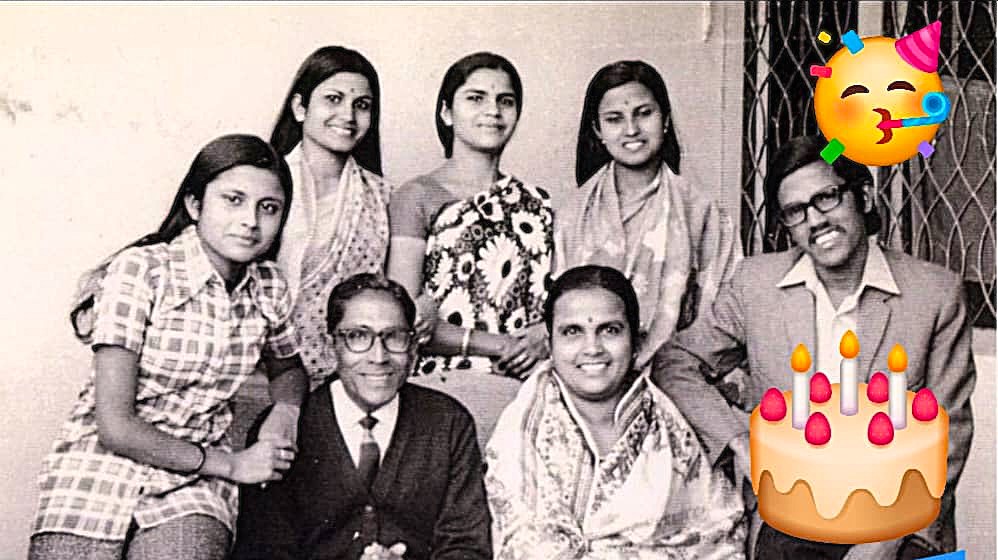
The show made us very emotional as it brought back many memories of reunions of our Extended ‘Sinha’ family. Our ancestors started with roots in Lucknow back in early 20th Century – we have now spread to many continents and on last count ‘Sinhas’ have forty members but maintain close family bonds and ties. Last year we had a grand reunion in Kolkata celebrating the Golden Wedding Anniverary of Shibani and Debashish. It was a gala event spread over 4 days. It was ‘Dining with the Sinhas’ sans huge superstars and their opulence. When big families celebrate together, it’s their bonding that matters !

‘Satyakam’ (Film – 1969)

(Watch on U-Tube)

‘Dharam ji’ at his Cinematic Best

When Dharmendra, the iconic & evergreen star, passed away on 8th, Dec., entire media was overwhelmed with glowing tributes for the superb actor, high praise of his immense body of work, life sketches of his legendary film career and the great human being he was. Mention of scenes from films like ‘Sholay’ and ‘Chupke Chupke’ got pride of place.

Yet, as an ardent fan and old film buff, despite his prolific portrayals in different roles spanning six decades, I have always felt that unarguably his best came in the sublime film ‘Satyakam’ a 1969 Indian drama film directed by Hrishikesh Mukherjee, based on a Bengali novel of the same name by Narayan Sanyal and the name inspired by ancient saint Satyakama Jabala. The protagonist is a bold, upright young Engineering graduate called Satyapriya who works in the terrains of Bhawanigarh in British-ruled India, with unwavering honesty & principles. The role played superbly by Dharam ji was considered by critics as among the finest in Indian cinema. The movie won National Film Award For Best Feature Film but sadly didn’t fetch Dharam ji the coveted Best Actor Award !

Influenced by the ideals he learnt from his grandfather Satyasharan Acharya, Satyapriya is a man of probity and truth and as a budding Engineer he has dreams of building a new India, but almost every character he encounters in his work-life experiences, share little of his ideals. His closest friend advises him to leave rigidities & follow the golden ‘middle path’ but Satyapriya argues that ‘Compromise is another name for surrender to wrong practices’ which he cannot. Ideological conflicts force Satyapriya from one job to another- unable to allow dishonest deals by officials & those part of a corrupt system.      

His tumultuous love & marriage ends in retribution too. Satyapriya hesitates in rescuing Ranjana, who loves him, and lets her become prey of the morally corrupt prince and to redress the mounting guilt, he later marries her, but their lives are never the same again while she bears a child. Satyapriya is constantly reminded of his failure, unable to adjust to the opportunism and greed that preys on the system, devoid of a strong moral fibre. His struggle continues to a poignant end that leads us into deep ethical introspection.

‘Satyakam’ with its idealism of truth and honesty appears surreal in today’s times but it had set a high benchmark for moral values in society that seemed to endorse beautiful message of the Mahatma ‘Be the Change You Want To Be’. In shorter parlance it would mean ‘Let’s Walk the Talk’, show the way for ‘Your Actions Speak Louder than Words’ !

In one scene, to his friend who advocates that Truth must not be so harsh and should be ‘Satyam, Shivam, Sundaram’ – Satyapriya says ‘If  You have the Courage to Speak the Truth, then have the Courage to Hear the Truth also’ ! But are ready for such idealism ? Surely this is the kind of narrative that we must bring home to our younger generation.

Cricket is “Phunny“ Game

If one were to borrow from William Blake’s famous quote, one might say ‘Flights may or may not take off but TV debates and the Cricket Series must go on..’ We avid followers of the game remain glued to our seats in packed stadia or in front of TV sets as India & Proteas are locked in riveting cricket contests. And for bigger aficionados, there’s also the ‘Ashes’ battle on between Aussies and the English..

For some, India’s fortunes in Cricket World attained greater significance than the scary AQIs, huge ‘Indigo’ turbulence in aviation sector and the dipping Re that’s now in the ‘nervous 90s’. The jargon dished out by experts on the Panel during on-going matches such as “Drop-in pitches”, “The Doosra“, “Upper Cut“, “Bat-speed“, “Reverse Sweep“, “Dil-scoop” create an aura of mystery & thrill to every match played.

Not surprisingly a large section of intelligent people cannot quite comprehend the basics of the game leave alone the nuances like “to bat first or not to bat is the question” looking to the flatness, turn, bounce off  the pitch and depending on the dew factor late evening. One Lady Stand-Up Comedian suggested in her show, a smart Woman can get anything out of her Man if she switches off  the ODI match telecast in the tense 50th Over !

Here are old gems from the not so cricketingly educated over the ages : Truly hilarious !

1.  In school, the teacher asked John to spell “ Bowling “. Back came the answer “ B-o-e-l-i-n “.  “ That “ said the teacher “ is the worst spell of bowling I’ve ever seen “ !

2.  Jones had taken his wife to cricket match. She sat through the first innings although very bored. In the second innings, a batsman tonked the ball out of the ground with a huge swipe. The wife got up excitedly “ Thank God they got rid of it, we can go home ! “

3. Wife to George “Do you remember the day you proposed at the cricket match. You were BOLD. “ No I wasn’t “ , George muttered “I was caught ! “

4. Jim and his wife were awakened by the baby crying . Jim dragged himself out of  bed to the baby’s cot and gently patted the baby with a cricket bat . “No bawl “.

5. The teacher asked the class to write an essay on cricket . With only few minutes left, one boy has written nothing. Suddenly looking at the clock he wrote a few words. “ No play today . Rain ! “

6. The bowler’s mother watched proudly from the stand. Next to her a spectator turned to his friend “He is good bowler, but his length varies“. “Nonsense“ said mother “He’s been five seven always!”

7. A mother asked her neighbour “Is it a sin if  he is always playing cricket ? “ Offended neighbour’s reply “ It is not a sin . But it is crime, the way he plays cross batted ! “

8. An expectant father rang the hospital to see how his wife was getting on . By mistake he was connected to the Lord’s cricket ground. “ How’s it going “ he asked. “ Fine “ was the reply “We got 3 out and hope to get the rest out by lunch. The last one was a duck !”

To Dear Nandini

‘On Reaching Ten’

Time has come, Grandpa said, To Think of many more Things,

Than Maths, Science,Geography, And Kingdoms, Queens & Kings

Find innate talent to Express, Don’t skip a Chance to Write,

Everything needn’t be Googled, Feel & Enjoy, Gain Real Insight,  

For You it’s the Best of Times, It is the Age of Learning Fast,

Man & Nature as Best Friends, Will Make Us Grow and Last,   

Not long, just few decades ago, Without the Genius Computer, 

Teachers used ‘Chalk and Talk’, Your Grandpa became Engineer,

 Today at ‘10’ Start Building Upon,  Ideas and Dreams of New Venture    

 The World is your Oyster, It’s Said, Make Every Moment an Adventure.

Happy Birthday Nandita !

Love and Blessings from Mama Dadu & Maima

7th, December, 25.

‘The Hound of the Baskervilles’ – Masterpiece of Detective Fiction

One risks being scoffed at in asking an educated audience (barring today’s Gen Zee) if  they’d read the ‘The Hound of the Baskervilles’. Most of our contemporaries and the Gen Next too would have savoured this novel not once but several times in formative years. Possibly the most loved & widely read crime fiction set in England’s Dartmoor, Devon, it’s a gripping tale of the deadly curse on the Baskerville family told through the legend of a diabolical hound and the super sleuth Sherlock Holmes who unravels the sinister plot and mystery surrounding it. The story is too well known to be repeated here.

When I had first read it what struck me was the sense of fear, foreboding and eeriness that master writer Sir Arthur Conan Doyle, creates as he weaves a story of honour and courage of the protagonist & cunning plot to kill and seek revenge that plays out in vast moors leading to a death-trap and and lurking in the dark, a vile blood-curdling creature that kills. It was first published in 1902 but was the third of the four ‘Sherlock Holmes’ mystery novels that Doyle wrote. This was reportedly the first appearance of Holmes since his apparent death in “The Final Problem” and the success of ‘The Hound of the Baskervilles’ led to the character’s eventual revival.  

What is fascinating apart from the timelessness of this crime fiction, that it’s recorded that there have been over 20 film and television adaptations of  the great book, making it one of the most filmed Sherlock Holmes stories, with notable versions including the classic 1939 film with Basil Rathbone, the iconic 1959 version with Peter Cushing, and several BBC TV serials, with specific versions appearing in the 1920s, 30s, 70s, 80s, and 2000s. However, my favorite actor playing ‘Sherlock’ has always been Jeremy Brett !

Yesterday, we happened to discover an oldish version of the film on ‘Fawesome’ Movies (surfing Amazon Prime) and Tandra and I sat down with lots of popcorn & soda, like old times when we watched old classics. As it happens, she has been an acclaimed teacher of English Literature and had taught ‘The Hound of the Baskervilles’ to school students years ago. For her, this was revisiting old ‘teaching’ days & had it’s share of nostalgia !

Her memory, sharp as ever could recall all the sequences and dialogues while passage of time had made things bit hazy for me and I tried to concentrate on the intricate plot and characters. But I needn’t have worried – she’d time to time let the ‘cat out of the story’s bag’ so to say..‘This guy is pretending that she’s his sister but actually she’s his wife’. At the opportune moment with the suspense building up, she revealed to me : ‘the gypsy is actually Sherlock in disguise’& so on. The film was quite enjoyable, I liked Sir Henry !

What’s good about watching a movie ? It’s watching & enjoying an old classic together !        

The Name is ‘Singho’

In one of the ‘Hoi-Choi’ Web-series, originally made in Bengali but dubbed in Hindi for larger group of audiences, the antagonist was the defense lawyer in a murder case and the plot was gripping. What, however, remained implanted in my mind was a name that is connected to my ancestors. The series shows everyone calling the well-known attorney as ‘Sinha’ to which he would invariably get up and correct them ‘It’s Singho, not Sinha’ !

This conversation would ring a bell to my Siblings & Relatives (all in their autumn years now and widely scattered, but the ‘Sinha’ family bonding remains strong ). After all, our Great-Grand Father was ‘Kali Prasanna Singho’ (son of ‘Bhola Nath Singhee’) who first settled in our home-place Lucknow in the early 20th Century. Through education and  diligence he could become a ‘Dist. Judge’ and earned fame for his cultural and social affiliations & with Bengalis like AP Sen, richly contributed to Lucknow’s literary growth.

For the uninitiated, the Bengali surname ‘Singho’ is a variant of ‘Singh,’ which means “lion” in Sanskrit and historically served as a title for warriors, royalty, and people symbolizing bravery and strength. It was adopted by various communities in Bengal, including the Kayasthas, and was sometimes associated with a noble or warrior lineage. The surname has olden roots in the broader Indian tradition of using “Singh” as a title. We came to learn from our Grandfather, NN Sinha, that his own & his elder brother’s surnames became ‘Sinha’ in course of time maybe to sound more upbeat and that has continued for the three generations that have followed them.

As ‘Provashis’ speaking Bengali at home, we grew up in Lucknow’s unique culture and charming ethnicity of the 1960s-70s. Our education gave us the best of both worlds imbibing clear diction in both English and Hindi laced with Urdu, typical of the city. We were proud of our surname that had a cosmopolitan touch much like Lucknow. Over time as our entire social fabric has evolved with implications on modern life-styles, opportunities & ideologies in different communities, we find there’s lot of  chopping and changing of names & dropping surnames, often to avoid being cast into typical moulds.

In the old-world thinking, we felt our parents had given us our identity with a lot of hope and expectations pinned to the ‘name’ and we’d all try our best to live up to them. In an interview years ago, the legendary Big B shared that he’d been told to drop his surname as it would made sound like a ‘Baccha’ (kid) in a hard-nosed film industry. His culture and upbringing made him insist on retaining his original name. ‘The Rest is History’ !    

December’s Here But What’s ‘AQI’ Like

Back in the 60s-70s, it was September-October that used to be the happy autumn time till global warming hit us and it lost its sheen despite all major festivals stacking up, one after the other, calls for forward planning specially if travel is involved or relatives visit !  Yet, there’s no respite from the soaring temperatures even to the most intrepid revelers.

The mantle of the coolest and most happening month has then fallen on December..Not just for its festive ‘Yuletide’ spirit but for being the merry season for ‘shaadis’ galore and chance to adorn three-piece suits, galabands and sherwanis on numerous celebratory functions, when ‘sons & daughters’ of relatives/friends decide to get hitched. The grand show must go on, never mind the ‘century making’ fuel, rising air-fares & tomato prices ! 

So what’s new with this year’s December. Like every year there’s the usual talk of smoke, fog, smog and polluted air specially around the Capital City and we’re advised to pause and think before breathing. Perilously high ‘AQI’ levels are garnering greater attention than given to ‘SIR’ (With or Without love !). Air Quality Index (AQI)  has been heatedly discussed every year for deterioration in Delhi’s highest echelons NCR & neighbouring cities, leading to ‘winters of discontent’ ! The problem has hugely exacerbated this year.

All those involved in the business of controlling the ‘AQI” levels, are well aware that it’s  affected by the deadly mix of pollutants that come from sources like vehicle emissions, industrial processes, power plants, farms’ stubble burning and managing city’s garbage as also natural events such as wildfires and dust storms. Massive housing & construction projects that are witnessed in all big cities never stop. Weather conditions, temperature, sunlight, and wind also influence their levels. 

Experts are debating round the clock but the ‘AQI’ remains a serious concern not only in the Capital & its vicinity but for all major cities. But what can we do ? Instead of showing anxiety we citizens can help reduce AQI by making conscious choices in daily activities related to using public transport, energy consumption, waste management, community engagement. Collective individual actions can significantly contribute to cleaner air. 

Finally, the weather experts are also predicting a harsher winter while the stock markets remain unpredictable due to geo-political uncertainties. But then December has had its contradictions being the birth-month of super-greats like Shakespeare and Einstein and down to Salman Khan ! A humble Sagittarian, I share my birth date with the icons like Brad Pitt and Steven Spielberg and my birth-month with living legends Thalaivar’ Rajnikant ! That said, in uncertain times let’s hope ‘Happier’ winter awaits for all of us ! 

‘Homebound’ ( 2025 Film)

Watch on Netflix

A powerful film can revive our memories of impactful experiences that might have taken place decades ago. At the age of ten I had seen a film called ‘Dosti’ (1964) with my Dad and little sister but by the end of it, we felt deeply moved with the story of tormenting trials and tribulations of two physically handicapped but inseparable young friends fighting against the common foe – ‘abysmal poverty’ ! I recall this for its strong imprint though many ‘friendship’ tales have followed over the years in different languages.

Director Neeraj Ghayawan (his ‘Masaan’ in 2015 shook us up with it dark intensity) tells the gritty story of two childhood friends from a small North Indian village who aspire for and diligently chase a police job which they feel will give them the dignity they’ve long been denied for impoverished backgrounds and social discrimination on basis of caste & religion. Their continuous struggle to earn a living and support their families run into systemic roadblocks and force them to forget their distant ‘cop’ dreams and find some work to keep afloat, faced with huge family burden. It’s a telling story of today’s youth !  

The film’s Credits reveal, ‘Homebound’ is based on a real story and is stark and heart-rending in its real-life depiction of the plight of our young-job seekers. The second half of the film is set against the backdrop of the horrors of the COVID-19 pandemic when millions of people – migrant labourers, factory and mill workers were all forced to make a perilous journey back to their homes, so many on foot, faced with strict lockdowns and helpless state of the looming joblessness and poverty.

Two brilliant young actors showing both fire and hopelessness in turn in their eyes, give truly memorable performances -Vishal Jethwa as young Chandan (a Dalit) and Ishan Khattar as Shoaib (a Muslim) win our hearts. Janhvi Kapoor in a cameo is effective too.  History repeated itself for us- two kids had shed tears for the tumultuous journey of friends in ‘Dosti’ back in 1965. Two senior citizens, my Wife and I, wept for some time after watching ‘Homebound’. Surely, Gen-Next deserves a better deal than what we see ! 

What Our Clocks Tell

While growing up we’d been made conscious of  it all the time – it’s ‘time’ to get up, leave for school, it’s ‘study-time’, ‘meal-time’, play-time and ‘time’ to rest and so on and of course there’s no ‘time’ to waste for despite being invisible ‘time’ has much value. We learnt the phrase ‘Time and tide waits for no one’ and the veritable man-made ‘Clocks’ symbolize the passage of time and the cycles of life, and have deep cultural and symbolic significance across history, art and religion.

We’ve also read that ‘Clocks’ have been used for centuries to measure time, even before devices like sundials and water clocks were invented. The modern generation has the latest in tech-gadgets but probably missed what we had in the 1960-70s – from ‘Cuckoo’ clocks that announced the hour with a cuckoo bird call to majestically tall, freestanding pendulum ‘Grand-father’ clocks with an elaborate design to the smaller ‘Mantel’ clocks that sat on a mantelpiece, shelf or table. There were others like smaller ‘time-pieces’ too.

It’s the hangover of our family heritage & parental legacy, that we have a clock in every room apart from the customary wrist-watches and cell-phones that every one possesses. But interestingly all three clocks show different times that are about ten minutes apart. After due thought, we’ve decided not to align all of them to the minute and let them be. Symbolically, if we individuals can be so different from each other despite having similar backgrounds, the clocks having their distinct origins must be allowed their space & time.

The quaint ‘Cuckoo’ clock was bought by us from a shop in Switzerland in 2013 and in keeping with its advanced origins it runs faster than all the others. The second one was a gift from a friend- it works fairly accurately, uncannily like the givers. The third one was actually a complimentary item along with a financial product. That one is the slowest. Finally we have a dainty ‘mantel’ clock that has slots for putting pictures on three sides and is the one we most love. It carries some of our grand-daughter’s earliest photos !

One realizes that today, modern interior designers don’t encourage putting up clocks that might give a period look to bold, exotic layouts. Some people, however, preserve the old clocks and antiques of their parental homes as family heirlooms. We’d fall in that category. We could restore a more than a century old ‘grandfather’ clock with the help of our ‘Uncle’ who was a genius with his hands. It stands tall in my younger Sister, Kalyani Bose’s home in Indiana, USA under her kind care ! 

Remembering Dad’s Favorite Song 

One of the great things about getting old is trying to become the person you should have been and having beautiful memories that must be kept alive. Most of all we remember fondly, people, places, incidents and things that leave a mark but today, being special, I recall wonderful childhood memories related to a SONG !

My earliest reminiscing starts in the 1960s with my Dad’s obsession for songs. As a boy, I remember the piece of paper he had, with lines ( lyrics) written in ‘Roman’ English. On select evenings he’d approach ‘Niluda’, a cousin who stayed in our house, to sing that particular number. Both went into a kind of trance singing that timeless melody and remarkably we got so used to this ritual that the tune and lines got etched in our hearts !

As we grew up and started enjoying film music of the Golden 1960’s (thanks to ‘Vividh Bharti’), Dad shared with us the ‘legend’ behind this quintessentially beautiful rendition from auteur director Bimal Roy’s path-breaking classic film ‘Sujata’ (1959). The film had actress ‘Nutan’ superbly playing a young girl, born to a lower caste but living in a family that gave her affection but the ‘class divide’ is too deeply entrenched for her to have a status and social acceptance. Till she meets the hero who falls in love with her, oblivious to her ‘caste’ antecedents.

Dad would regale us with the backroom story.. iconic Dada SD Burman composed and sang memorable songs for this film, but no suitable situation could be conceived for a romantic song by the hero. Finally SD came up with a brilliant idea – the hero serenades the lady on the phone as she silently listens & weeps to it – ‘Jalte Hain Jiske Liye, Teri Ankhon Ke Diye, Dhood Laya Hoon Wohi, Geet Main Tere Liye..’ Talat Mahmood’s sublime, soft voice lends great depth and poignancy to it. Later, I read in the book on  Dada Burman- in his early days he’d often entertain his friends by singing on the phone.  

On our Dad’s 104th Birthday today, I quietly recede into my study to sing in his memory this ageless composition, remembering and marveling at the great taste he had in songs, music and literature, which he passed on as his legacy to our generations to follow.