Friends

Some of the most endearing stories that can win hearts and inspire faith in humanity are those that are to be found in lasting friendships. As the old adage, if recast in the today’s grim scenario, would go – ‘you can’t choose your relatives, you don’t pick your boss, you mightn’t trust your luck with the new house-maid or driver’ – but most certainly you can bank upon your old friend/s. As Henry Higgins (remember ‘My Fair Lady’) would say to his long standing companion, Col. Pickerin, ‘Why can’t they be more like you’ ?!

In a strife ridden world of antagonism, rancor and mistrust, there have also been many exemplary characters whose irrefutable friendships have stood the test of time. We also have our learnings from our mythology of the kind of unshakeable faith and ties that existed between Lord Krishna and Arjun, Karna and Duryodhan, Lord Ram and Sugreev and many such legends.

My favorite friendship stories come from the world of sport where though men and women strive to outdo each other in sporting competiveness many forge alliances which last lifelong. Tennis legends Bjorn Borg and John McEnroe fought many an epic battle on the court but ended up as best of friends, so much so, that Borg was best man at John’s famous wedding !

From our own sub-continent, is  cricket’s wonderful camaraderie between arguably the best opening ODI pair India has ever produced – Sachin Tendulkar and Sourav Ganguly, who together featured in over 8800 runs in partnership. Their mutual admiration and friendship has lasted 30 long years and is the stuff that legends are made of. On his 46th birthday two days back, ‘Dada’ got special wishes, written in chaste Bengali from the ‘God of Cricket’, Sachin !

The subject of friendship became the theme for one of America’s longest running popular sitcoms ‘Friends’. The players became household names and actress Jennifer Aniston a superstar. Interestingly it also started a great bonding between Jennifer and actress Courtney Cox for all times to come. This when it’s believed two actresses cannot be good friends !

Hollywood with its rich history has many lovable anecdotes on friendship. The lead actors of the magnum opus ‘Titanic’ – Leonardo De Caprio and Kate Winslet after enjoying all the acting accolades from the monumental movie, went on to forge a lasting friendship which has continued for over two decades !

How can one miss out on Hindi cinema’s great friendship stories which are many but to me the most poignant and eternal were the ones between the ace actors and those who provided their golden singing voices – Raj Kappor and Mukesh, Dev Anand and Kishore and Shammi Kapoor and Md. Rafi !

It would not be entirely right to say that the present generation with all its intensity and passion, possibly cannot keep up to the demand of enduring friendship but that’s how it appears to old-timers. I remember my father’s friends stick by him (and he to them ) right till their autumn years. That gentile tradition has continued – we too can proudly say  that some of us in our ‘old friends’ group have had the same strong ties for the last over five decades !

What then is lasting friendship all about ? As usual , the Bard puts it best – ‘ A friend is one who knows you as you are, understands where you have been, accepts what you have become,  and still gently allows you to grow ’ !

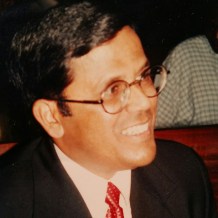
Vipin

Why not a Banker’s Biopic

Whilst Mumbai is facing another round of hearty monsoons showers , it’s going to be raining biopics in Hindi films, given a massive boost by the astounding runaway success of  ‘Sanju’, Hirani’s slice of life and times of the once beleaguered but ever-popular, film star Sanjay Dutt (despite it’s fair share of outraged detractors, outraged critics and mixed reviews).

According to the tabloids after some well-made biopics on our legendary wrestlers, boxers, sprinters, cricketers, actors and even underworld dons, there are a surfeit of real-life stories of achievers under research to be turned into saleable movies. In fact there are two films almost ready for release on our achievers in hockey ( Soorma and Gold ) while badminton golden girl Saina Nehwal’s success story is to be portrayed by actress, Shraddha Kapoor. Sports provides awe-inspiring tales like India’s famous 1983 first Cricket World Cup victory, now being made into a film !

Coming to other themes, the most exciting is the historical blockbuster on the legendary, Rani Laxmibhai being portrayed on screen by redoubtable ‘Queen’ Kangana Ranaut. Hrithik Roshan is undergoing an image makeover to play the genius mathematician, Ramanujam in yet another fascinating biopic to be completed soon.Another, interesting take is on Rakesh Sharma, India’s first astronaut into space, to be played by King ‘Shahrukh’ Khan ! The list would go on as the cult of biopics has caught the fancy of audiences.

In all this, some amazing tales of people in less glamorous professions, like banking and finance, are being overlooked. Though a biopic is on, featuring Ex-PM Dr. Manmohan Singh, based on the book ‘The Accidential Prime Minister’ with the versatile Anupam Kher enacting the role, the film would hardly deal with his stint as a Banker (RBI Governor) and dwell on politics.

When PSU banks are facing so much heat over the NPAs and high volume frauds, a biopic on the life and challenges of an eminent banker would reveal another side of the banking story. Among many great bankers that India has produced, my vote for a biopic goes to SBI’s ‘Lady of Substance’ !

State Bank’s first woman chairman. Arundhati Bhattacharya, after joining the country’s largest lender as a probationary officer worked for 40 years. Her journey started at the bank’s main branch in Calcutta with large manual ledgers all around and ended with the bank embracing cloud computing. In her interviews, she has revealed that she wanted to become a journalist and calls her entry into banking an “accident”. After leaving her imprint in every department of the bank, post-retirement she plans to do a PhD in banking and finance, as per reports.

Despite astounding success as a banker, Ms Arundhati remained grounded and pragmatic in her approach to her work and her people and took many pro-employee measures apart from being regarded as a financial expert in the country. In 2016, she was named the 25th most powerful woman in the world by Forbes. In the same year, she was ranked among the FP Top 100 Global Thinkers by Foreign Policy Magazine. She was named the 4th most powerful women in Asia Pacific by Fortune. In 2017, India Today magazine ranked her at 19th in India’s 50 Most powerful people of 2017 list.

There would be so much to enlighten us about the working of a large PSU behemoth in a biopic, if made – why not have Vidya Balan as Arundhati ?

IMG-20171218-WA0007_resized


What’s Up with WhatsApp

In a highly competitive world, strong on letting out emotions, aggression and urge to control, the voices of rational thinking individuals is a far cry. Today so overwhelming is the emotionally overpowering content visible in the social media that one’s thinking is drowned in the barrage ! For a long time there have been people ‘shooting from the lip’ and with a penchant for sensational revelations and opinions based on obscure facts. Add to this is the ability to ‘verbally fire’ first and apologize later if there is a ‘storm in the tea-cup’ or the established ‘apple-cart is getting upset’ !

With ‘WhatsApping’ becoming the most handy means of communication for sharing of news, views and ideas between groups, there appears to be an alarming rise in misinformation with malicious intent, leading the authorities to hasten the implementation of measures aimed at curbing the spread of fake news which have triggered serious incidents of violence in the country. Also, in a mad race of being one up, there’s a blitz of forwards, without checking source, facts or data, to impress others.

Why do some people behave so irrationally on the different platforms, even if they have no ulterior motives or axe to grind. Communication experts have another term for this- ‘An Amygdala Hijack’ – an immediate and overwhelming emotional response out of proportion to the stimulus because it has triggered a more significant emotional threat. The Amygdala is the part of our brain that handles emotions. During an Amygdala Hijack, the Amygdala “hijacks” or shuts down the neo-cortex or the rational thought processing of the brain. The Amygdala is responsible for the perception of emotions such as anger, fear, and sadness, as well as the controlling of aggression. The Amygdala helps to store memories of events and emotions so that an individual may be able to recognize similar events in the future.

We all undergo ‘Brain-fade’ some time not only on the social media but in all spheres of living. Quite frequently, we ‘lose it’ while bumbling into over-crowded trains to work /travel, negotiating impossible vehicular traffic, dealing with unruly people, non-sympathetic bosses, civic authorities, difficult suppliers/vendors and debates with younger family members in the inevitable generation gap ! The trick is to get hold of yourself when the ‘Hijack’ is getting triggered and get into the pause mode and take a deep breath. No action at that point is the best action ! Why indulge in antics for which you have to say sorry later – pause now to smile later !

(pic source : mirrorcitizen.dailymirror.lk)

Whatsapp cartoon

What a Mess(i) !

Shakespeare in his incomparable style had a distraught ‘Macbeth’ ponder ‘Tomorrow and Tomorrow … Life is but a walking shadow, a poor player who struts and frets….’ in one of his immortal tragedies of epic proportions.The lines highlight the fickleness of fame and fortune, success and victory which all mortals must face – even if it’s Lionel Messi, currently rated the world’s best soccer player. That fateful Saturday night when Argentina crashed out of the World Cup against a raging red-hot French team, that gave them no quarters to equalize the score, many dreams were shattered !

A disconsolate Messi may now announce his retirement from international soccer bringing down the curtains to what can be described as an incredible career spanning about two decades. It’s so fascinating that at the age of 31, Messi has been considered the best soccer player in the world and regarded by many as the greatest of all time in the tradition of the great Maradona.

Born in Jun,1987 as Lionel Andrés Messi Cuccittini, the remarkable story of his life started in Central Argentina. Initially not strong he was diagnosed with a  growth hormone deficiency as a child. At a very young age of 13, he relocated to Spain to join Barcelona and later made his competitive debut  aged 17 in October 2004. Thus began the spectacular era of Lionel Messi.

Having played professional soccer for the Spanish Club ‘Barcelona’ with  whom he spent his entire career and of course his own Argentine National  Team, over the years, Messi has been one of the most prolific goal scorers and creative playmakers having been the recipient of innumerable awards, prizes, trophies for his teams and huge recognition in the soccer world.

Messi became the youngest Argentine to play and score in a FIFA World Cup during the 2006 edition, and reached the final of the 2007 Copa America , where he was named young player of the tournament. As the squad’s captain from August 2011, he led Argentina to three consecutive finals: the 2014 World Cup, for which he won the Golden Ball, and the 2015 and 2016 Copas America.

FIFA 2018, will be remembered not only for its many upsets (with last year’s champions Germany and Ronaldo’s Portugal making early exits ) but also for becoming swan song of possibly one of the most gifted and classy  practitioners of the wonderful game of football !

Messi himself has been quoted as saying “My motivation comes from playing the game I love. If I wasn’t paid to be a professional footballer I would willingly play for nothing” ! Apt words from a truly great sportsman of this generation.

messi


‘Sanju’ – Biopic with a Heart

Unlike many other enterprising people I don’t rush in for first day shows preferring to wait for reviews to educate or pre-warn of the impending three-hour experience ! For  ‘Sanju’ we made an exception simply because somewhere there’s always been a soft spot for that marvelous and maverick actor who made the ‘Munnabhai’ character a cult with his bohemian ways and cavalier style !

It’s also easy to understand the complexities and risks in constructing the biopic (albeit with shortcomings and omissions) of three hours, spanning four decades of the turbulent life and times of actor Sanjay Dutt (Sanju) – wayward, errant and junkie star-son, turned sought after superstar turned law-breaker and jailbird – the only son of such respected and celebrity parents as veteran actors, political  luminaries like Sunil and Nargis Dutt !

The film is not a classic in the league of ‘Munnabhai’ franchise or “Three Idiots’ which made director, Raj Kumar Hirani, a master-teller with his finger on people’s pulse. Yet it comes with it’s own strengths of a pulsating screenplay, sardonic doses of humor and moving intensity of human relationships.

‘Sanju’ is the resurgence of Ranbir Kapoor as an outstanding actor who lives the role of a helplessly weak, self-destructive, impetuous youth who wittingly or otherwise constantly got on the wrong side of law but later came to terms with his many misdemeanors, finally incarcerating himself with serving a jail sentence but not before getting his name cleared from the TADA accused list.

The other side of this remarkable story is the highly principled and upright etching of great moral stature of Sunil Dutt’s character, brilliantly portrayed by Paresh Rawal – in fact the film can also be a tribute to the fine qualities that Sunil Dutt possessed as a man and a father, the relentless battles that he fought for his son on various fronts till the end. There’s a moving fictional speech which Sanju prepares for his father for he can’t thank him enough for drawing him out of abyss of failure to a life of meaning !  Paresh Rawal’s superlative act is supported by a superb power performance by Vicky Kaushal and a sweet cameo by Manisha Koirala as Nargis Dutt.

Finally the misses, which are quite a few. Understandably to keep everyone appeased, nothing is spoken of his various affairs with his co-stars but why  have no mention even of his first wife and daughter from her. In a film dominated by larger than life figures and lots of  bromance between Sanju and his life-long friend, the female characters are low key including Sanju’s sisters and stars Sonam Kapoor and Anushka Sharma seem quite inconsequential in their roles.

Despite its omissions and indulgence, ‘Sanju’ is a moving experience that’s all about frustrations, hope, endearment and lasting relationships. In the last scene, Sanju himself tells his son “Try to become like my Father, don’t try to be like your Father !”.

I specially felt happy when my wife said after the movie ‘Thank you, Sanju ’ – you see my nickname too is Sanju !

Sanju

RD and the Great “Pancham” Swar

It is absolutely heartrending and so reassuring that ‘class’ is permanent and can never fade as was the musical genius of the incomparable R.D. Burman and fondly known as “Pancham” and whose 79th Birth Anniversary yesterday was marked with many celebrations !

After a spate of remixes of his superb creations by lesser equipped musicians and directors, there remains sheer all round admiration among followers of all ages of the original – his immense creativity and innovative processes far beyond his time. Along with musical shows to commemorate the occasion, 91.9 FM radio has a month long morning slot in his memory with contributions from many of his protégés.

While purists have their own thinking of the western influence and mix in Pancham’s tunes, there are many classical gems like ‘Aayo Kaha Se Ghanshyam..’ sung beautifully by Manna Dey in “Buddha Mil Gaya”, the incomparable compositions in films like ‘Amar Prem’, ‘Parichay’ and ‘Ghar’ and chartbusters with classical flavours and also with folk music like the Kishore special ‘Meri Pyaari Bindu…’ from ‘Padoson’. It would be such pleasure to have 91.9 FM also playing lesser known gems like  ‘Jaane Kya Sochkar..’ by Kishoreda from ‘Kinara’ , ‘Kya Hua Kis Baat Par..’ by Amit Kumar from ‘Teri Kasam’, and ‘Kiska Raasta Dekhe..’ from ‘Joshila’ again by Kishore, apart from super-hit favourites from ‘Hare Rama Hare Krishna’, ‘Sholay’ and ‘Hum Kisise Kam Nahin’ !

While RD forged a life long alliance with the virtuoso songstress Asha Bhonsle culminating in marriage, his best and unforgettable tunes were reserved to be rendered by the versatile Kishore, who was well on his way to a superb comeback as the voice of superstar Rajesh Khanna in the 70s( and later equally effective as the voice of Amitabh Bachan !) – RD’s effervescent music formed a formidable combo with them and Kishore till the late 80’s. It seems with the passing away of Kishore in mid-80s and the advent of crass culture in Bollywood music, RD started losing his touch with the Hindi film industry which had revered his talent for so long.

As a devoted fan and follower of the father, S.D.Burman and then his son, R.D. for the last forty five years, one thing baffles people like us. While many stars have received recognition and rewards far beyond their actual worth, at times, true legends like these have often not been applauded in the same measure. In the case of Pancham, how could the industry suddenly disown and get disenchanted with his melody till he came back with a blockbuster like “Love Story-1942” as his swan song !

Despite being the son of a legendary music director, RD created his own style and flavor of modern Indian music which withstood the test of time ! Today, the world of Hindi cinema remembers RD as the pioneer of innovation in film music, an ‘avant garde’ in his quintessential musical sensibilities which all composers revere and would love to emulate !

RD Burman

( pic source : hindustantimes.com )

June’s Here, Can ‘Mumbai Rains’ Be Far Behind ?

In Hrishida’s delightful 70’s breezy comedy “Chupke Chupke’, the dimpled heroine bashfully sings ‘Ab Ke Sajan Sawan Mein, Aag Lagegi… ’ to conjure up visions of idyllic joy and gay abandon, welcoming the monsoon rains, while Big B in one of his earlier films, croons Kishoreda’s evergreen melody ‘ Rimjhim Gire Sawan, Sulag Sulag Jaye…’ with the same heady romance. These are only two of the many scores of musical treats dedicated to the rains by the imaginative Bollywood song-writers since decades, so much so, that a song-dance rain sequence was mandatory in Hindi films till some time ago.

Why do rains bring such emotions of liberation and mystic adventure with all its myriad hues, lush greenness and even rainbows on odd days ?! What deserve special mention are the famous ‘Mumbai Rains’  that typically hit the metropolis (and the state) in June first week and last about two months. The famed ‘Mumbaikar spirit’ is known as much by its undeterred ability to weather the lashing winds and heavy downpours as being enthralled by the lyrical ‘monsoon’ flavors akin to the surreal aura created in our films !

The love Mumbai has had for it’s rains is simply quite incomparable. The maximum city that runs over each other all throughout the year and where, life in general and commuters in particular, mean no less than a struggle, all takes a break for good month or two as it breathes the cool ‘monsoon’ air that brings the soaring temperatures and sultriness down dramatically.

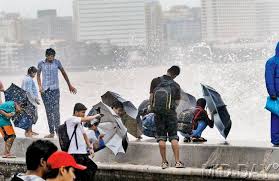
There are certain experiences that everyone living here should have to make the Mumbai rains a memorable one. One of my first cultural initiations to this city was the walk along the iconic Marine Drive with Arabian Sea winds blowing across a strong drizzle. Watching huge waves lashing the rocks on Bandra Bandstand or the Worli Sea-face is another major draw for people  across the megapolis, while thousands throng the Juhu beach in the rains. The historic Gateway of India is the perennial tourist’s delight with ferries and catamarans plying across turbulent waters of the Arabian Sea for a thrilling experience. What add to the ‘monsoon’ flavours are the eateries working overtime – from ‘chai, vada-pav and bhujias’ of the road-side vendors to the classy, quaint cafes of South Mumbai, the range is awesome !

Over the years, with the teeming millions that have made Mumbai their home, the endless high-rises springing up to cater to them, ineffectiveness of the BMC to keep the roads travel worthy, authorities continually engaged to extend the metro rail network and such other factors have put immense pressure of city’s infrastructure and drainage system-consequently every monsoon becomes a nightmare for commuters with almost all major roads getting water logged, potholes galore, dilapidated buildings, trees crashing down, local trains delayed, buses, cars getting caught in huge traffic snarls ! Maximum city’s ‘monsoon’ joy is slowly transforming into maximum woes.

Yet with Mumbai there’s always hope that things will surely improve – for Mumbaikars will yet say  ‘Jo Bhiga Hai, Woh Baarish Se Nahi Darta Hai..’ !

Mumbai Rains

Banking – The Going Gets Tough

Navjot Sidhu is a man of many apt words (now less heard though) and he once described Indian team’s predicament on a bad day in the field as ‘ .. lying flat on it’s back and the only way it can look is – upwards !’ With all the battering that the PSU banks are being subjected to, it could well their story but unlike our cricket’s fortunes there’s no ‘VIRAT’ standing up for them.

To make matters worse are certain opinions in the media on the nuances of banking from such sections that has never seen the inside of a modern PSU bank. The image of PSU banks, alarmingly in the last two years has suddenly transformed from ‘people’s friends’ to ‘social parasites’ and Govt’s bogey, with their staggering bad debts, massive doses of capital  infusion required and the recent spate of banking-related scams, thus making them synonymous with big frauds, malfeasance and poor corporate governance.

For instance a famous pulp fiction writer had articulated in a leading paper ‘..it really isn’t hard to hatch a plan… can imagine the wild party in progress inside those dusty PSB branches’. As much as it’s lurid sensationalism from the author, for justifiably outraged stakeholders it might appear factual, given the magnitude of frauds coming to the fore.

It is as if overnight the PSU banks (which have been beasts of burden for populist govt. schemes for years on and have always paid the price  for it) have become ‘bad boys’ of the financial world and most of them barring the gargantuan SBI, need to bunched or merged together to stem the rot ! The alternative to safe and sound banking being projected are the ‘blue eyed’ private sector banks looking lean (less NPAs) and good (making profits). This impression was working well till the largest private bank and it’s redoubtable Chief were rocked by conflict of interest allegations that have set in motion many actions and have raised concerns of corporate governance in private banks.

In its efforts to portray a strong intent to come down heavily on wrong doers in terms of suspected cases of large bank loan frauds detected in PSU banks, the prime investigative agencies have started summarily arresting and taking into custody, the Heads and Top Management teams (previous and existing  in cases) and widely publicizing these actions in the media, even without really establishing their direct involvement, connivance and any malafide intentions, provoking strong protests from the IBA and PSU bank unions.

For people who spent better part of their existence having served with diligent integrity and more importantly, the large community of literally a million employees committed to their long working hours in some 21 PSU banks, what is the morale like and who’s addressing it ? Apart from a early rebuttal from the MD of SBI group on the ‘private good vs public bad’ issue of banks and a few stray voices from the wilderness of retired groups of officers, there seems to be not much coming out from the promoter/owners and the management to dispel the gloom spread all around and meet the challenge fairly and squarely highlighting stringent action where necessary.

Major battles have been fought by PSU banks from many fronts in it’s long history. It’s well-known internal weaknesses of low margins and strengths of reach and spread and myriad external factors must be addressed by the Govt. and regulators.The bigger war against NPA and credit related frauds has to be fought by a determined and dedicated army led with ‘Churchill’ like tenacity by its owners and leaders and regulators much as depicted in the Oscar winning film ‘The Darkest Hour’ !

( pic source : danscartoons.com )

Banking

‘Jamai’ Celebrated In ( law ) Style

This Tuesday was special to many a married Bengali as it happened to be “Jamai Shasti” or the old Bengali tradition of honouring  the Jamai or son-in-law. This noble festival is classless as it is freely extended to all Jamai’s, the good, the new and even the retired ! Doting mothers-in-law bless their Jamai with gifts and more importantly, delectable Bengali fish and variety of Bhajas and sweets and what have you, for the gallant role they might have played (or are expected to play) in the growth and prosperity of  the family. Wives i.e. the daughters also take part but are not over-excited with all the hoo-ha over the men, as if to say “Why spoil them further in these difficult times!”.

Why is this special celebration for sons-in-law in this day and age of gender equality, one may well ask. The traditional festival of Jamai-shasti originated ages ago as a part of a women’s socio-religious duty. The son-in-law is called ‘Jamai’ and ‘Shasti’ means sixth, thus the festival is observed on sixth day of  Shukla Paksh in Jyestha month of traditional Hindu calendar. The  popular social custom lays foundation of a strong family bonding. All the son-in-laws get a treat from their in-laws or ‘Shoshur bari’. While the day is celebrated since olden days by the Hindu families all over West Bengal it is equally popular in other parts with Bengali influence spreading far and wide.

As the festival plays vital role in bringing the son-in-law closer to the girl’s family, the traditional Jamai gradually becomes “Gharer Chele“ (local guy) and helps to make family ties sound, sorts out home matters, arranges marriage alliances for younger sisters/brothers and maintains diplomatic ties all around. However, the modern day “Jamai” appears to have got lost in the time-warp and is often found to distance himself from complicated family issues, agreeing  to meet /visit in-laws and even relatives only on special occasions like marriage or sagaai within close family !

Being a “Jamai” has its share of burdens  as the great Big B himself would agree. Being married to a Bengali (Jaya Bhaduri), he is embraced by effusive Kolkata as their Jamai and is so besieged by family and friends for gracing various occasions and inaugurating functions. Of course it helps that he spent his initial years as a professional in Kolkata before becoming an actor. Rest is certainly, Indian history !

Everything said and done “ Jamai Shasti “ is recognition of the tireless efforts of the good “Jamai” to maintain order and peace under all circumstances and for all those against this, I would only exhort  “ It is better to be a Jamai and observe “Shasti“ than to be free with no Shashur Bari !”

Jamai Shasti

Revisiting Malthus ?

Natural disasters happening with alarming frequency – earthquakes, tycoons, storms, deluge of floods all over the world. Alternating between certain years of droughts are torrential rains in various parts of our country, presently inundating some of our North-Eastern states. Too close for comfort are the spells that paralyze life, disrupt public transport and maroon many parts of our ‘maximum city’ Mumbai – also a startling reminder of the famous economist, Robert Malthus and his classical work we read in our post-graduate classes famously known as the ‘Malthusian theory of population growth’.

We would recall that Malthus examined the relationship between population growth and resources and arrived at the theory that population growth occurs exponentially, so it increases according to birth rate. On the other hand, food production increases arithmetically, so it only increases only at given points in time. Thus he had derived the postulate that, left unchecked, populations can outgrow their resources.

There are two types of ‘checks’ that can reduce a population’s growth rate according to Malthus. Preventive checks are voluntary actions people can take to avoid contributing to the population. Because of his religious beliefs, he supported a concept he called moral restraint, in which people resist the urge to marry and reproduce until they are capable of supporting a family. Positive checks to population growth are things that may shorten the average lifespan, such as natural calamities and disease, warfare, famine, poor living and working environments. The startling prediction was that eventually these positive checks would result in a Malthusian catastrophe which is a forced return of a population to basic survival.

Though later contested by many economists, the subsequent industrial revolution and technological breakthroughs in almost all fields, the Malthus postulates conceived some three centuries ago, suddenly appear too close for comfort.

As  one noted ecologist has opined ‘ while global warming is exacerbating environmental disasters, the root causes often lie in poor planning, disregard for good science and citizen apathy’. Studies now reveal that global warming is expected to make vegetables significantly scarcer around the world, unless new growing practices and resilient crop varieties are adopted and environmental changes such as increased temperature and water scarcity may pose a real threat to global agricultural production with likely further impact on food and health and lives of people.

Of greatest concern is the recent report from India’s think-tank Niti Aayog that our county may be heading for its worst water crises and almost 800 million people may face acute water shortage very soon. It also estimates that demand for water will be twice as much as the available supplies by 2030. What will it do to our economy and people ?

All this highlights the crying need to protect the environment, curb the staggering pollution levels that are engulfing our cities, develop alternate sources of energy, control unbridled population growth and bring about an abiding balance between man and nature – bereft of which, the future doesn’t seem to look very bright for the next generation.

( pic source : the nextweb.com )

pollution